Let us first try to
understand the geography of India to know our roots.

On three sides India is
protected from invasion; by the Himalaya Mountains on the north, and on the
east and west by the sea. But on the north-west side, along the line of the
Indus, it is vulnerable to attack. On this side, she was successfully invaded in
ancient times by the Persians, the Greeks, and the Indo-Scythians. Later, in
modern times, she was successfully assailed by the Turks under Mahmud Ghaznavi
and Muhammad Ghori, and by the Mongols under Babur.
The Persian rule in N.
W. India lasted for about two centuries, 500 B.C. to 330 B.C, from the time of
Darius to the invasion of Alexander the Great. The Greek dominion lasted for
about three centuries, from BC 330 to BC 26, when the Kabul valley and the
Punjab were conquered by Kujula, king of the Kushan Scythians. The flourishing period
of Indo-Scythian rule lasted for about three centuries, from B.C. 26 down to
the end of 3rd century A.D. when it met the Gupta dynasty, that was rapidly
consolidating power in the Gangetic plains of Northern India.

(source: https://www.historyfiles.co.uk/images/FarEast/CentralAsia/Map_Bactria-&-India-50BC_big.jpg)
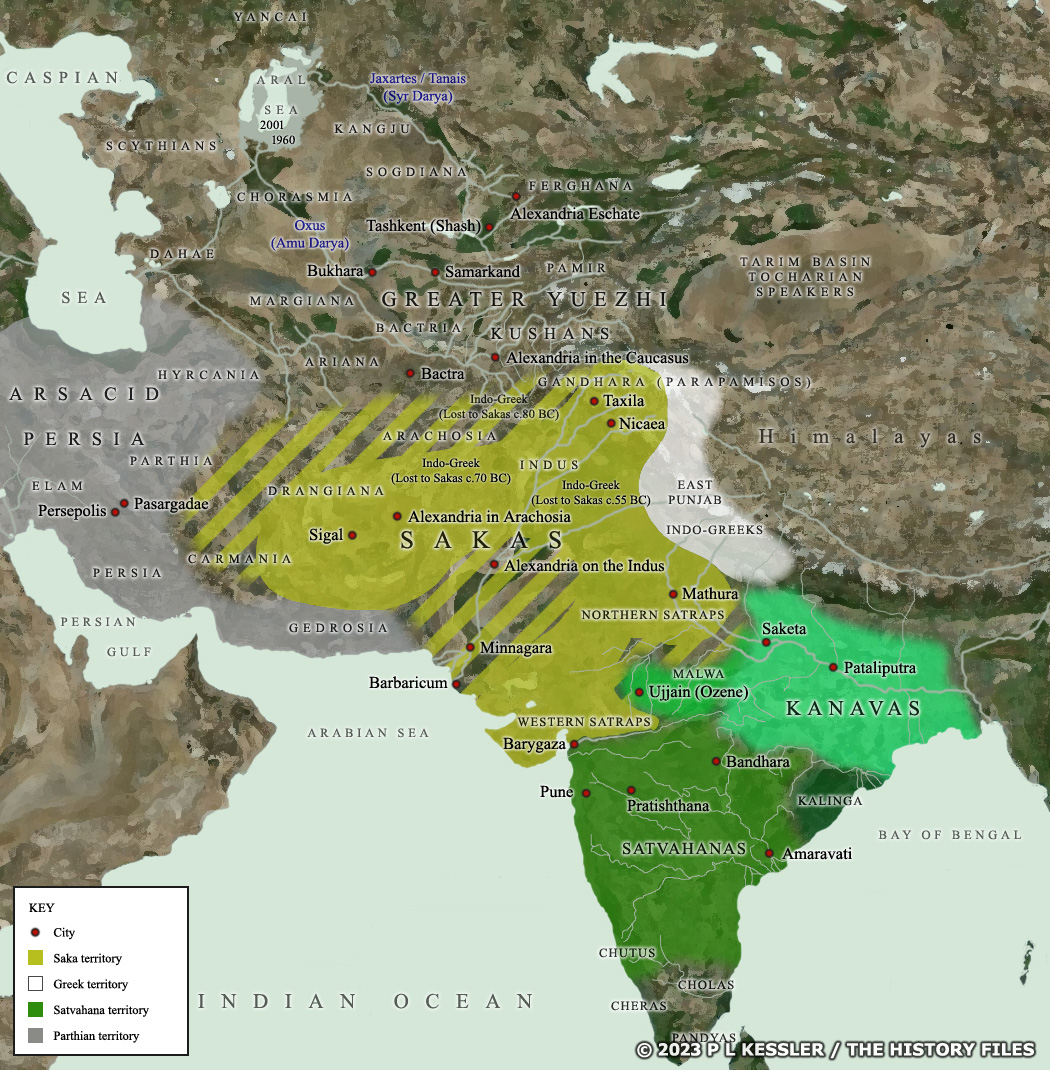
These Indo-Scythians were
a subset of the much larger nomadic tribe known as the Scythians, the Sakas or
the Indo-Iranian Sakas. The question is… Who are these people and in the present
time, where do they exist?
We have no records of
his people’s great poetic epics, their popular songs, their typical dishes or
courtship rituals or favorite jokes, because they did not write. We don’t know
whether they even thought of themselves as a single people, or as more of a
confederation, or even a subculture. However, we can derive some knowledge from
the coins, they had issued when they ruled upon India.


The hints we do have,
though, are tantalizing. Almost everything we know about this people (or these
peoples) comes to us from their neighbors — literate civilizations like the
ancient Assyrians, Greeks, Achaemenid Persians, and even the Zhou Chinese.
Their own word for
themselves almost certainly comes from the Iranian root sak– “to go; to roam.”
This word lent them the name by which they were known most widely in their
heyday, among the peoples they fought, raided and traded with, all across the
vast continent of Asia: in Old Persian, they were the Sakā. In ancient Greek,
Σάκαι. In Sanskrit, Śaka. In Old Chinese, Saik.
In their own tongue,
they called themselves the Saka — the Ones Who Roam. But we know them today by
the name Herodotus gave them: the Scythians.
At their peak, the
Scythians ranged freely across the vast belt of steppe-land that stretches from
Hungary, Turkey and Ukraine in the west, to northern China in the east; from
the Arctic Circle in the north to Iran and Afghanistan in the south. While they
were nomads, they did realize one thing… They have unlocked a genuine real-life
superpower by domesticating the horse. With this, steppe life would never be
the same. From the interior of the steppes, waves of new class of warriors now started erupting outward across Europe and Asia.

For the first time in
human existence, speed and distance were no longer limited by legs. People
could fly now, sailing above the ground atop thundering hooves. Hunters could
range across dozens of square miles every day in search of food — and warriors
could ride for distant battlefields to raid their enemies (Reminds me of Dothraki
from “Game of Thrones.”).
Where now it is
possible to find Scythians?
They are now known as
Kazakhs… in the modern-day Kazakhstan


Modern day Kazakhstan
In terms of Ease of
doing Business, Kazakhstan ranks better than the other Eurasian countries.
The World Bank’s International
Bank for Reconstruction and Development’s Doing Business 2018 report ranked
Kazakhstan 36 out of 190 for “ease of doing business” and 6 out of 190 for
“enforcing contracts.” The country was also ranked number 1 for “protecting
minority investors.” A World Bank Group Central Asia Regional Program overview
published in December also highlights that in 2017, more than 60% of all FDI to
the region was invested in Kazakhstan. Thus, the level of foreign direct
investment is among the highest in the former Soviet Union. The United States
is one of the largest investors in the market along with the Netherlands and
China.
Its GDP based on PPP
was ranked 43rd globally. The unemployment rate was at 5% in 2015. (Source: www.worldatlas.com)

Kazakhstan is the
biggest economy in Central Asia and is reliant on massive deposits of natural
resources such as oil, gas, and other minerals. The country also has a
landscape that favors considerable agriculture such as livestock keeping and
grain production. The country is hugely reliant on the exportation of oil, and
this has affected its revenue especially in 2016 where there was a global slump
in the oil prices. The country’s industrial sector is reliant on the extraction
and manufacture of the minerals and the production of heavy machinery. The
disintegration of the former USSR negatively affected the value of its GDP.
Leading Industries of
Kazakhstan
The primary drivers of
the country’s economy are ore, manganese, chromite, lead, and zinc among
others. Agriculture is also very essential accounting for 5%, industry 35%, and
service 60%. The country also produces and exports oil and gas in hundreds of
thousands of metric tons. It also produces uranium accounting for 35% of the global
production and the second uranium reserves deposits after Australia.
Kazakhstan’s vibrant service industries are related to technology and retail.
In 2015 the country ranked 13 out of 30 in Global Retail Development Index.
Challenges to The
Economy of Kazakhstan
The heavy reliance by
the country on the revenue from oil and oil products has at times negatively
impacted its economic growth. The market forces in the international arena
determine the prices which have hampered its ability to plan financially. The
country has experienced a contracting GDP and budgetary deficits on account of
the problem.
These fluctuating commodity
prices have thus exposed the economic volatility of Russia and Kazakhstan. They
now no longer trust on oil and gas as a major source of their incomes and
therefore want to diversify their sources of revenue to cushion the negative process
that are created by falling oil prices in the international market.
Future plans
Kazakhstan has launched
an ambitious economic diversification plan under the ‘Kazakhstan 2050 economic
agenda’.
Kazakhstan is
continuously working to increase the foreign direct investments. In 2014, the
government signed into law tax concessions designed to increase the FDI. It
included a ten-year exemption from corporate tax, an eight-year exemption from
property tax, and a further ten-year freeze on other forms of taxes. The
government has also reduced VAT and other forms of levies. These measures are
aimed at attracting foreign investors to boost the economic growth of
Kazakhstan.
However significant
challenges remain in improving the Ease of doing Business Climate. This
includes lack of privatization, corruption, governance issues, inadequate
amount of skilled human capital etc.
The economic reforms
enacted under the Complex Privatization Plan for 2016-2020 are aimed at
improving the country’s business and investment climate through measures that
eliminate red tape and improve intellectual property protections. The idea
behind the change is to use common law principals in commercial law to foster
best practice in corporate finance.
The four-year plan
covers over 900 facilities that are in the process of being privatized or
reorganized and re-registered under the government. Several profitable sectors
of the economy including agriculture, metallurgy, domestic and transnational
railways, and ICT are now offering IPOs. The government also hopes to digitize
the economy and increase broadband reach to modernize and support the new
Kazakhstan.
As per StartupBlink (the
world's most comprehensive startup ecosystem map and research center), Kazakhstan
is ranked at number 69 out of 100 top startup ecosystems globally as per
mapping and research center for startup environment of countries globally. It
ranks low due to poor logistics and infrastructure.
However, the
government is taking steps to attract startups by creating innovation
technology parks, hubs, and accelerator programs. As a part of this endeavor,
Kazakhstan is looking to boost its startup ecosystem seeking support from the
world’s third-largest startup ecosystem — India.
Kazakhstan is looking
to implement the startup listing platform and support offered by the Bombay
Stock Exchange (BSE) to startups and small businesses at the Kazakhstan Stock
Exchange (KASE) based in the country’s financial hub Almaty. If materialized,
this would be the fourth one to be established by BSE.
The other three
platforms are as follows
·
first, an incubator
in collaboration with Ryerson University and the Simon Fraser University of
Canada;
·
second, SME platform
with close to 300 companies listed;
and
·
third, startup
platform for young hi-tech companies.
|
India’ trade with Kazakhstan
India’s
current trade with Central Asia is minimal – just about $1.5 billion which is a
mere 0.11 per cent of India’s overall trade.
India’s Trade with Central Asian Countries in 2017-2018
(Values in US $ Millions)
(Values in US $ Millions)
Country
|
Exports
|
Imports
|
Total
|
Kazakhstan
|
125.37
|
907.43
|
1032.81
|
Kyrgyzstan
|
28.59
|
30.94
|
59.53
|
Tajikistan
|
23.94
|
50.29
|
74.24
|
Turkmenistan
|
54.31
|
26.15
|
80.46
|
Uzbekistan
|
132.72
|
101.67
|
234.39
|
Total
|
364.93
|
1,116.49
|
1,481.21
|
Source; Department of Commerce: Export Import
Data Bank
http://www.commerce.nic.in/eidb/ergnq.asp updated on 14/08/2018
http://www.commerce.nic.in/eidb/ergnq.asp updated on 14/08/2018
As
noticed from the table, India’s trade among all the C5 countries of Eurasia is
largest with Kazakhstan. Uzbekistan is a distant second. At this moment, Indian
companies enjoy a lot of expertise in management
of cooperatives, manufacturing devices for health monitoring, pharma and
generic medicines, disaster management, agribusiness, academic engagement, IT and
service sectors etc.
Currently, Kazakhstan
supplies uranium concentrate to India, oil, asbestos, steel, salt, sulfur,
lime, cement, raw hides and ferrous metals. India exports to Kazakhstan include
coffee, tea, spices, tobacco, organic chemical compounds, pharmaceutical
products, plastics, rubber, rubber products, electrical machinery and
mechanical equipment.
Kazakhstan is ranked fifth in the world in terms of consuming Indian
tea and imports 12.61 million kg annually. Kazakhs are amongst the highest
tea drinkers in the world with a per capita consumption of 1.5 kg annually,
that is, an average of 5 to 6 cups a day, a reason why many people are
labelled as "tea drunkards". Given the enormous popularity of tea,
the Kaznet website was created for "tea drunkards".
Unfortunately, India’s
tea exports to Central Asia during 2013 have been reduced to 208.26 million
kilograms as against 211.86 million kilograms in 2012. India’s market
share is lost to tea from Kenya and Sri Lanka. However, the popularity of
Indian tea remains high in most Central Asian countries. To rectify and
regain its market, the Indian Tea Exporters’ Association (ITEA) or Indian Tea
Board should take the initiative of setting up a simple tea blending &
packing factory in Central Asia to offer best quality Indian teas to the tea
loving people of the region.
Apart from tea, pharmaceuticals represent the largest
component of the Indian export basket to Central Asia worth USD 151.41
million or 28.14 per cent of total exports. Most of the large Indian
companies are represented in the market. Given India’s strong position
in this sector, Indian companies should push for aggressive marketing to
expand their market share. There are almost ready opportunities for Indian
companies to establish joint ventures and manufacturing units of
pharmaceutical products in the region.
Under the Belt and Road initiative, the region is
experiencing a real boom in the construction and infrastructure sector. New
business centres, shopping malls, cultural centres, sports complexes, roads,
etc are being planned in the cities along the oil-rich Caspian region in the
west. There is a huge potential for large Indian companies to tap this opportunity
by bidding for road and railway construction projects, electric power
transmission and distribution, telecommunications, power generation, etc.
|
With plans to improve
the state of connectivity from India to Eurasia, gaining more and more chorus
among Indian businesses, India is now firmly planning to establish a quadrilateral
connectivity corridor (India-Iran-Turkmenistan-Kazakhstan).
Plans are afoot to
link Gujarat's Mundra Port with Bandar Abbas and connect it to
Iran-Turkmenistan-Kazakhstan railway network and onwards to Eastern Russia.
The idea is to not only access markets of this landlocked region but also
create a corridor to import natural resources from the region in a shorter
period than being done currently, according to officials. To facilitate visa processing speed
for businesses, Kazakhstan has recently established its consulate in Gujarat.
 |
Kazakhstan in a
member of Eurasian Economic Union. With the Preferential Trade Agreement
(PTA) between member states of the Eurasian Economic Union and Iran, expected
to enter into force by end of 2019, Indian business can further increase
their potential to export their finished goods to Kazakhstan via Iran by
integrating Iran into their Global value Chains (GVCs).
Additionally, with sanctions
on Russia, their MNCs are also moving out of it. If India signs a Preferential
Trade Agreement (PTA) or a Free Trade Agreement (FTA) with Eurasian Economic
Union (EaEU) of which Russia is also a member, India will be able to attract
these companies willing to reexport their products to Russia and Eurasia.
However, this should
be taken with a pinch of salt. With sanctions on Russia because of its
alleged interference in the affairs of Ukraine and Georgia, the prices of
Russian currency also known as ‘Ruble’ is falling. This makes their products
cheaper compared to the ones manufactured in Kazakhstan. Consequently, it has
been found that Russians are now dumping their surplus capacity of steel in Kazakhstan.
Arcelor Mittal (now headquartered in Rotterdam) has established production
capacity in Kazakhstan to tap the lucrative market in Russia and the larger
Eurasian Economic Union. However, now it is suffering huge losses since it is
unable to compete with this cheaper steel, that is dumped by Russia in Kazakhstan.
If India signs FTA
with EaEU, this casualty can also happen with India.
|
Space cooperation
There already exists
agreement between India and Kazakhstan related to space research. Both ISRO and
the National Space Agency of Kazakhstan have signed an agreement to help and
co-operate with each other in space activities.
The Central Asian
country is host to the famous Baikonur Cosmodrome. Though it is a major
research Centre in space, Kazakhstan hopes to work together with ISRO in
research and development of satellites. Negotiations are going on between the
space agencies of India and Kazakhstan on the possibility of developing a space
communication system (satellite) KazSat-2R.
Other areas of
cooperation and development of ties between businesses in India and Kazakhstan include
areas of IT such as digital connectivity and e-network, education, health and
academia, fintech and cybersecurity, banking and financial inclusion etc.
Kazakhstan is a close
ally of Russia. This is by virtue of the fact, that even after breaking away
from Soviet Union, the Kazakhstan business still have strong connections with
Moscow. Russia borders 7000 km with Kazakhstan and is her largest trading
partner. 40% of all population residing in Russia are ethnically Russians.
In fact, it was
Kazakhstan that proposed Eurasian Economic Union (EaEU) and has always
participated in Russian led institutions like CSTO, EuraSec, CIS, Eurasian
Customs Union (EACU) and off course EaEU.
|
There have been
several changes in the political landscape in the geography of Central Asia —
Russia is now willing to play a larger role in geopolitical affairs. Since Kazakhstan
is the largest country in Eurasia, it is now emerging as a critical power in
the Central Asia region. With this, Kazakhstan is now looking to increase its
presence in Central Asia by fostering ties with India to facilitate a
North-South trade corridor. Thus, it is also important for India to look at
Kazakhstan as a stepping stone into the markets of Central Asia and develop
an outreach strategy to connect to Central Asia to compete with the growing
presence of China in that region.
With the entry of
China as a major player in funding key infrastructure projects in the region
under the umbrella of B&RI, Kazakhstan is wary of Chinese intentions. Most
of the investment done under these projects have very little transparency and
are economically unviable. Kazakhstan, as a part of its multi-vectoring
policy is willing to diversify its relations, to reduce its dependence on a
handful of countries as a source of FDI.
Other challenges faced
by Kazakhstan is the extremist ideologies and terrorism emanating out of Afghanistan
due to ongoing political instability, lack of infrastructure to bring its
products out of its region south to the borders of India, and geopolitical
challenges concerning the weakening influence and capability of USA to deter
other major powers.
|
India is seen as a
non-interfering nation and a risk averse country. Respect for other countries
territorial integrity, sovereignty and the right to self-determination have
always been the backbone of India’ foreign policy.
Kazakhstan borders
Xinjinag region of China. Uyghur Muslims form 1.5% of overall population of
Kazakhstan. What is the perception of China towards Kazakhstan? With growing
investments from China under the B&RI, what should be the role of India to
help Kazakhstan exert its sovereignty?
|
Energy resources of
Kazakhstan
Kazakhstan has 12% of
the world’s uranium resources and became the leading uranium producing country
in 2009. By 2011, Kazakhstan was the world’s largest uranium producer. India
has therefore signed a civil nuclear agreement with Kazakhstan. In January 2009,
Kazatomprom signed an agreement with India’s Nuclear Power Corporation (NPCIL)
to supply 2100 tonnes of uranium to India for the time period 2010-2014.
Kazakhstan is a part of
NSG grouping by virtue of being part of the nuclear supply chain (because it
exports raw material i.e. Uranium). Kazakhstan also supported Indian case to
get the NSG waiver in the year 2008.
Since Kazakhstan has
such a huge amount of uranium, Russians used to do all the testing of their
nuclear weapons in Kazakhstan at a site known as Semipalatinsk when it was
under the former Soviet Union. However, the moment, Kazakhstan got
independent, it destroyed all the nukes inside its territory and tried to
make the entire region a Nuclear Weapons Free Zone (NWFZ).
In the Iranian
nuclear deal that was negotiated by the Obama administration, the Iranians
were proposed a safer option to send all their surplus Uranium (beyond the
agreed limit) to Kazakhstan. This is due to the fact, that they still possess
technical know-how on managing Uranium and storing the same. Although not
reported, it is also suspected that Iran has tried to employ few Kazakh
scientists in its nuclear program who became unemployed after the local
Kazakhstan government shut down the nuclear program that was inherited from
the former Soviet administration.
|
Kazakhstan has abundant
coal, uranium and gas reserves. ONGC Videsh Limited and KazMunaiGaz have signed
an agreement in April 2011 to purchase 25% stake in the Satpayev Oil Block in
the Caspian Sea was signed in Astana. Since, Kazakhstan has a huge network of
oil and gas pipelines, it can be connected to the TAPI gas pipeline network in
future.
However, it should also
be understood that the juridical status of maritime boundaries of countries
surrounding Caspian Sea is still unresolved. This is leading to an arms race in
that region, which may hurt Indian interests of tapping oil and gas in this
region.


The republic possesses
considerable reserves of iron, vanadium, molybdenum, gold, industrial diamonds,
mining-technical (vermiculite, asbestos, wollastonite, bentonites etc.) and
mining-chemical raw materials. (phosphorites, barytes, fluorite, sulphur etc.)
It has considerable
resources of halite, potassium and manganese salts, sodium sulfates and
borates. There are huge reserves of a face and ornamental stones, construction
materials, mineral and thermal waters.
Western Kazakhstan is
known as the heart of iron ore. It lies in magnetite and sedimentary deposits
of brown iron ores of northern Kazakhstan. Total volume amounts billion of
tons.
Among all the C5
countries in Eurasia, Kazakhstan has the highest per capita GDP followed by
Turkmenistan and then Uzbekistan. However, diving further deep reveals that
per capita GDP of Uzbekistan is only 25% of Kazakhstan. This shows the extent
of disparity in the entire region.
|
In a larger picture, the
rate of growth (in terms of PPP) of C5 countries taken together is hardly 4%
of China and 22% of Russia. Does this mean, that they are so much backward
than India?
|
Military to Military
ties
For thousands of years,
a Kazakh tribe has trained Golden Eagles in the region’s barren alpine
mountains to swoop down and capture foxes for food and furs. Hundreds of miles
from the nearest city, tribal families live without electricity or running
water, and they rely on the eagles for survival. Goat and cattle herders, they
move three times a year, following the animals and the pastures, selling meat
and dairy along the way.
This deep understanding
extends to the local Golden Eagle population. According to tradition, when a
young boy is 13, his father begins to train him to hunt with eagles. The tribe
captures young female eagles who are not yet old enough to fly, raise them, and
after seven years return them to the wild to breed.

After independence in
1991, the golden eagle become the national symbol of Kazakhstan. It can also
be spotted on the Kazakhstan flag.
Every year, the U.S.
Central Command conducts multi-lateral exercise with Kazakhstan. They are
known as Exercise STEPPE EAGLE.
As part of the
exercise, military personnel from the United Kingdom, India, Kyrgyzstan,
Tajikistan, Turkey, United States and Uzbekistan jointly worked out various
elements of peacekeeping operations.
The tasks included
serving at checkpoints, escorting and convoying humanitarian supplies,
negotiating with local population, patrolling areas, clearing mined fields
and roads, cleaning and providing water and carrying out first aid treatment.
The exercise has been
conducted since 2003 in order to improve the peacekeeping skills of the
military personnel in the course of performing joint theoretical and
practical tasks.
India Kazakhstan
joint exercise is known as Kaz-Ind.
The fourteen-day
joint training exercise held in 2018 aims to build and promote army to army
relations and exchange skills and experiences between Indian Army and the
Kazakhstan Army.
Counter terrorism and
training
The primary focus of
the Kaz-Ind exercise was to train and equip the contingents to undertake
joint counter insurgency and counter terrorist operations in urban and rural
environment under mandate of United Nations. It had provided an ideal
platform for both contingents to share their operational experience and
expertise while also being instrumental in broadening the interoperability
and cooperation between the armies of India and Kazakhstan.
|
While not discussed in
our media, India and Kazakhstan can also collaborate on R&D in defense. If calculated,
the potential for exports of weapons and equipment by DRDO and their equivalent
organization is immense.
Since major of the
weapon systems in the Indian Armed Forces is of Soviet era, there is scope of
joint ventures with Kazakh companies for the production of torpedoes and
related systems for the Indian Navy. Also, the companies have expertise for the
Indian Army and the Air Force.
Kazakhstan’ role in global
governance
In the year 2019, Kazakhstan
Peacekeeping Company has been deployed with the Indian Army’s JAT Infantry
Battalion in the United Nations Interim Force in Lebanon (UNIFIL) for
peacekeeping operations. All the reimbursement- paid for service in UN
peacekeeping- for the Kazakhstan troops will be routed through India.
This is a first time;
Kazakhstan has sent its own troops for peacekeeping operations. At the same
time, this is also the first time that Indian Army unit has taken the command
of a foreign army contingent.
While this a big
boost to the military-to-military diplomacy between India and Kazakhstan, this
is also indicative of the fact that the country wants to play a larger role
in global governance. Kazakhstan is also the largest country in Eurasia. By virtue
of it, should India support its aspirations to become a ‘P’ member of United Nations
Security Council (UNSC)?
|
We hear a lot about
overseas aid coming from the US and EU, but it is far less well known that
Kazakhstan has been providing aid to other countries for the last two
decades. Currently, active work is being undertaken to establish a national
official development assistance operator in the form of an agency,
provisionally called KazAID.
KazAID is the first
ODA programme among the Central Asian states, and one that will have a
neighbourhood focus. The new agency will also fit with Kazakhstan’s broad,
long-term strategy to make the country a regional hub for international
diplomacy.
This initiative if
seen, in the light of the ongoing process of withdrawal of U.S. and allied
International Security Assistance Force (ISAF) military from Afghanistan, shows
that Kazakhstan is highly concerned about the political instability that can
derail its own development and the region. Can India and Kazakhstan work
together in Afghanistan?
|
Those who are further
interested to explore Kazakhstan are requested to watch this documentary
or can also visit the
following interactive website on the following url
To download the software
that gives a detailed information of foreign policy of Kazakhstan, pls click
here
To download the app for
android, pls click here
To download for iOS,
pls click here
Comments
Post a Comment